Gridlee: the game keeps its credits twice
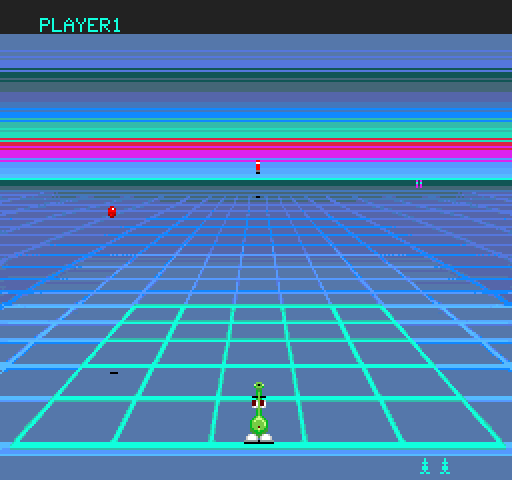
Videa's Gridlee (1983) runs on a 6809. This demo drops three coins into it and looks for the credits with a value scan, which ends on three bytes, not one. Watches on two of them show why: the coin routine counts in binary in one and in BCD in the other.
What you are watching
inputpressed START and a credit is spent: the game is on.state_writeloads the saved state andinputdrops a coin: CREDITS goes from 4 to 5.
The ROM
mamedev.org distributes this ROM for free, non-commercial use, from its own site only, so it is not in this repository. Get it and check it with your MAME:
$ mkdir -p ~/roms$ curl -fL -o ~/roms/gridlee.zip https://www.mamedev.org/roms/gridlee/gridlee.zip$ mame -rompath ~/roms -verifyroms gridleeRun it
$ uv run python demos/gridlee/demo.py --rompath ~/romsEach line it prints is one call and its check. The window opens behind the others, so the run does not take your keyboard.
--binary PATHpicks the MAME to start. Left out, it isMAME_BINARY, else themameon yourPATH.--display Nopens the window on that display. Left out, it opens on the main one.--transcript PATHmoves the whole transcript; the run's other files go beside it.--update-readmerewrites this page's generated parts,TRANSCRIPT.md,screen.png,loop.webpand the README's example calls, from a run where every step passed. It needs ffmpeg andimg2webpon yourPATH.
Exit codes: 0 every step passed, 1 a step failed, 2 a usage error, 3 nothing was demonstrated. That last one is a missing ROM, a relative path or a server that did not start.
Try it yourself
Add the server to your client and ask it to start gridlee with
the ROM in ~/roms. Each of these is a step of the demo, in the order the demo makes them.
Three coins are in. Keep only the bytes of the scan that hold 3 now.
scan(method="filter", operator="=", value=3){
"summary": "scan filter: = 0x03, 3 left",
"hits_total": 3,
"hits": [
{"addr": "0x000003ee", "value": "0x03"},
{"addr": "0x0000042b", "value": "0x03"},
{"addr": "0x0000042c", "value": "0x03"}
]
}Three bytes hold 3, and a scan cannot say which is the credits. "3 left" counts the bytes still in the scan; the watches of the next step tell them apart.
The whole reply
{
  "summary": "scan filter: = 0x03, 3 left",
  "status": "ok",
  "operator": "=",
  "value": "0x03",
  "iterations": 3,
  "closed": false,
  "hits": [
    {"addr": "0x000003ee", "value": "0x03"},
    {"addr": "0x0000042b", "value": "0x03"},
    {"addr": "0x0000042c", "value": "0x03"}
  ],
  "hits_total": 3,
  "truncated": false,
  "cpu": ":maincpu",
  "space": "program",
  "session": {
    "alive": true,
    "running": false,
    "altered": false,
    "omitted": ["altering_writes", "console"],
    "how": "<volatile>"
  }
}Change watches are on 0x42b and 0x42c and a fourth coin is in. Run half a second and tell me what stopped it.
run_for(milliseconds=500, seconds=300){
"summary": "run_for 500 ms: OTHER_STOP, frame 672 to 673",
"verdict": "OTHER_STOP",
"cause": "watch 0x42b: 0x0000042b written by pc 0x0000b583"
}OTHER_STOP means a watch stopped the run before its half second ended. cause names the byte and the instruction that wrote it.
The whole reply
{
  "summary": "run_for 500 ms: OTHER_STOP, frame 672 to 673",
  "status": "ok",
  "verdict": "OTHER_STOP",
  "frame_before": 672,
  "frame_after": 673,
  "emulated_before_s": 11.371026,
  "emulated_after_s": 11.372898,
  "cycles": 2340,
  "reads": "<volatile>",
  "cause": "watch 0x42b: 0x0000042b written by pc 0x0000b583",
  "stop_seq": 10,
  "pc": "0x0000b586",
  "cpu": ":maincpu",
  "frame": 673,
  "regs": {
    "A": "0x01",
    "B": "0xcf",
    "D": "0x01cf",
    "X": "0xf609",
    "Y": "0xf2e6",
    "U": "0x7afa",
    "PC": "0xb586",
    "S": "0x07fc",
    "CC": "0xa0",
    "DP": "0x00"
  },
  "instruction": {
    "address": "B586",
    "bytes": "8601",
    "text": "LDA    #$01",
    "symbol": {"available": false, "why": "no symbol table places this address"},
    "delta": {"available": false, "why": "no symbol table places this address"}
  },
  "following": ["B588: BB 04 2C ADDA   $042C", "B58B: 19       DAA", "B58C: B7 04 2C STA    $042C", "B58F: 39       RTS", "B590: 96 F4    LDA    <$F4", "B592: 27 21    BEQ    $B5B5", "B594: 96 B3    LDA    <$B3", "B596: 84 07    ANDA   #$07", "B598: 26 1A    BNE    $B5B4", "B59A: 8E F6 59 LDX    #$F659", "B59D: 96 F5    LDA    <$F5", "B59F: 27 03    BEQ    $B5A4", "B5A1: 8E F7 49 LDX    #$F749", "B5A4: CE 0A 85 LDU    #$0A85"],
  "errorlog": "<volatile>",
  "watches": [
    {
      "ref": "0x42b",
      "cpu": ":maincpu",
      "state": "armed",
      "reading": {"available": true, "value": 4, "raw_hex": "04"}
    },
    {
      "ref": "0x42c",
      "cpu": ":maincpu",
      "state": "armed",
      "reading": {"available": true, "value": 3, "raw_hex": "03"}
    }
  ],
  "omitted": ["addr", "by", "entry", "fmt", "length", "mode"],
  "how": "<volatile>",
  "watch_hit": {
    "ref": "0x42b",
    "addr": "0x0000042b",
    "cpu": ":maincpu",
    "index": 1,
    "writes_total": 1,
    "truncated": false,
    "writer_pc": "0x0000b583",
    "writes": [
      {"wrote": "0x04", "to": "0x0000042b", "pc": "0x0000b583"}
    ],
    "values_from": "memory",
    "before": 3,
    "after": 4,
    "lines": ["Stopped at watchpoint 1 writing 04 to 042B (PC=B583)"]
  },
  "session": {
    "alive": true,
    "running": false,
    "altered": false,
    "omitted": ["altering_writes", "console"],
    "how": "<volatile>"
  }
}Disassemble 12 bytes from 0xb583, where the first watch stopped.
disassemble(ref="0xb583", length=12){
"summary": "disassemble 0xb583: 5 lines at 0x0000b583",
"lines": [
"B583: 7C 04 2B INC $042B",
"B586: 86 01 LDA #$01",
"B588: BB 04 2C ADDA $042C",
"B58B: 19 DAA",
"B58C: B7 04 2C STA $042C"
]
}The coin routine increments $042B, then adds one to $042C in BCD (ADDA, DAA, STA). The game keeps its credits twice, in binary and in BCD.
The whole reply
{
  "summary": "disassemble 0xb583: 5 lines at 0x0000b583",
  "status": "ok",
  "ref": "0xb583",
  "addr": "0x0000b583",
  "length": 12,
  "lines": ["B583: 7C 04 2B INC    $042B", "B586: 86 01    LDA    #$01", "B588: BB 04 2C ADDA   $042C", "B58B: 19       DAA", "B58C: B7 04 2C STA    $042C"],
  "cpu": ":maincpu",
  "flow": ["unknown", "unknown", "unknown", "unknown", "unknown"],
  "flow_source": "none",
  "note": "no mnemonic table for cpu type 'm6809' (tables: m68000, v30), so no line is classified",
  "session": {
    "alive": true,
    "running": false,
    "altered": false,
    "omitted": ["altering_writes", "console"],
    "how": "<volatile>"
  }
}START was pressed and a watch stopped it. Show me the last eight instructions.
history(limit=8){
"lines": [
"D68D: RTS",
"C5AD: JSR $D676",
"D676: DEC $042B",
"D679: LDA #$99",
"D67B: ADDA $042C",
"D67E: DAA",
"D67F: STA $042C",
"D682: RTS"
]
}history lists what the CPU ran up to the stop, oldest first. START takes a credit from both counters: DEC $042B, then the BCD one by adding 99.
The whole reply
{
  "summary": "history: 8 instructions of 8 asked",
  "status": "ok",
  "asked": 8,
  "lines": ["D68D: RTS", "C5AD: JSR    $D676", "D676: DEC    $042B", "D679: LDA    #$99", "D67B: ADDA   $042C", "D67E: DAA", "D67F: STA    $042C", "D682: RTS"],
  "cpu": ":maincpu",
  "session": {
    "alive": true,
    "running": false,
    "altered": false,
    "omitted": ["altering_writes", "console"],
    "how": "<volatile>"
  }
}
The whole demo as one prompt
- Start
gridleewith the ROMs in~/roms, checked against its first program ROM (CRC 1C43539E) as the reference image at0xa000. - Let the attract mode run for five seconds, then open a value scan over
0x0, 2 KB. - Three times: drop a coin (
:IN1,Coin 1, four frames), run two seconds, and keep only the bytes that equal the coins so far. - Put a watch that stops on a change of
0x42band another on0x42c, and drop a fourth coin. - Run half a second at a time until both watches have stopped the machine and a third half second runs clean; tell me which instruction writes each.
- Disassemble 12 bytes from
0xb583, read both bytes and save a state. - Press
1 Player Start, run one frame on after the first stop, and show the last eight instructions and the registers. - Clear both watches, record 480 frames to an AVI, read both bytes and take a picture.
- Load the state, read both bytes, drop a fifth coin, record 120 frames, read them again and close.
Tools this demo uses
| Group | Tools |
|---|---|
| Session | start, close |
| Run | run_for |
| Scan | scan |
| Breakpoints | watch_add, declaration_clear |
| Read | read_memory, disassemble, history, registers |
| Lua | input |
| Sequences | perform |
| States | state_write |
| Screen | screen_view |
| Captures | record |
Each group is a page of the reference. Four of the names need a word:
- Run: the tools that let the program run and stop it again.
- Breakpoints: breakpoints and watches.
- Sequences: the tools that run several calls as one.
- Lua: the tools that reach MAME's own scripting,
inputamong them.
The transcript
TRANSCRIPT.md has every call of the run with its reply. The run reached the
ROM and MAME through links under the repository's own tmp/, so its paths read the same on
any computer.
More demos
 LineUpThe arcade LineUp, from the game's own ROM set, played by its own routine and variable names.MAME · DOSBox-X
 Star FireExidy's Star Fire, a free ROM, from a cold start to the instruction that counts its coins.MAME
 Speed FightThe arcade Speed Fight, from a copy of the game, started from a file in its
.scry/folder.MAME · DOSBox-X